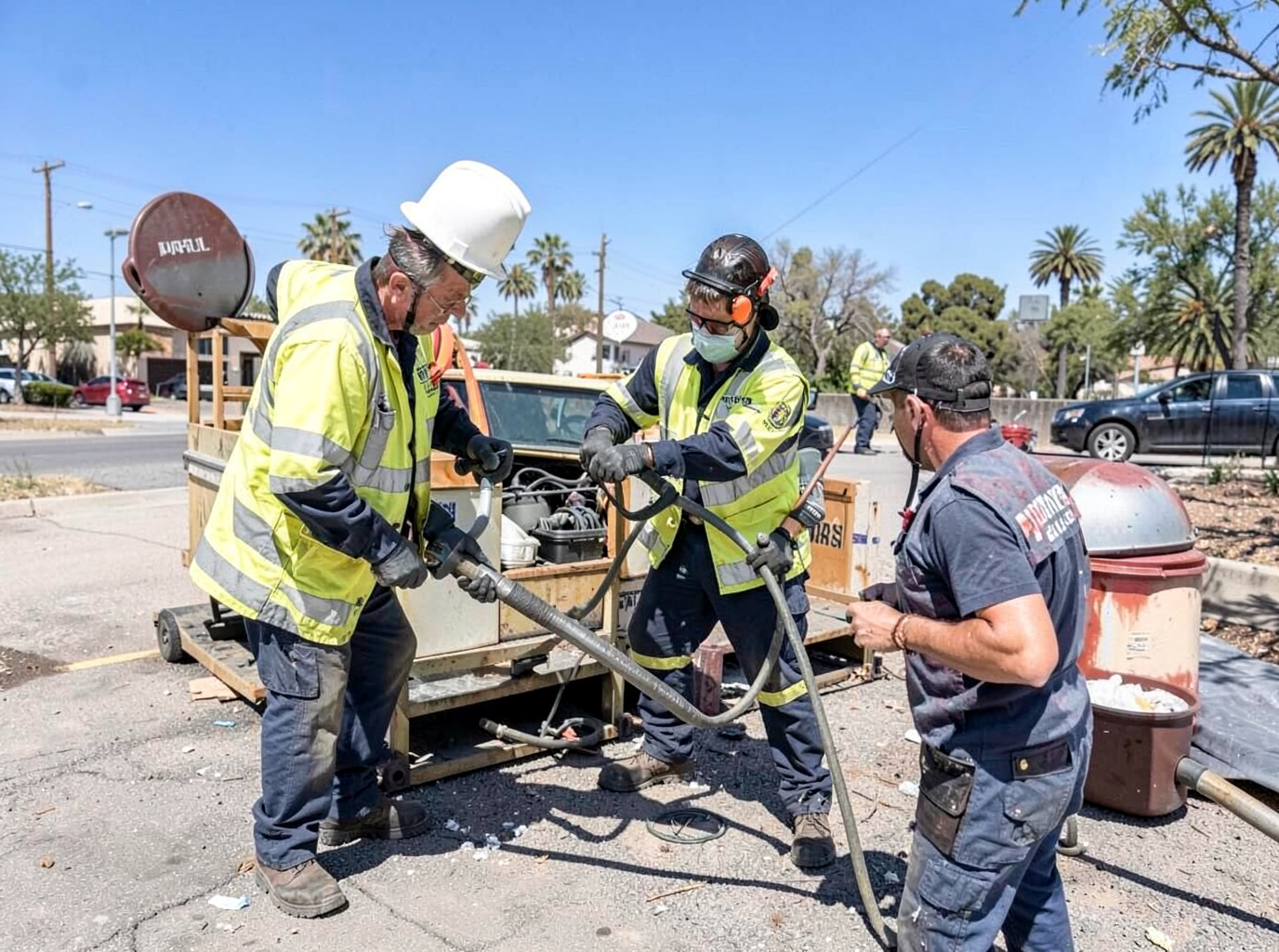
Moreno Valley summers push temperatures over 100 degrees, driving rapid evaporation that leaves hidden moisture in stucco and slab foundations common in Edgemont and Sunnymead tract homes built from the 1970s onward. Emergency water removal crews must extract standing water within hours or risk trapped moisture migrating under flooring and into wall cavities near the March Air Reserve Base flight path where vibration can loosen already compromised seals.
Lake Perris releases and winter rains send runoff across the flat terrain into Moreno Valley Ranch and older neighborhoods east of the mall, often overwhelming French drains installed decades ago. Technicians use truck-mounted extraction units sized for these clay-heavy soils that hold water longer than sandy Riverside County lots, preventing hydrostatic pressure from pushing water back through slab cracks after the initial pump-out.
Many homes along Perris Boulevard still rely on original galvanized supply lines that corrode faster in the area's hard water. When a line bursts, water can travel under the slab toward the garage or laundry room before surfacing, requiring targeted extraction along the perimeter rather than a simple center-room pull to avoid leaving pockets that later feed mold during the mild winter months.
Technician insight
In Moreno Valley the thing that catches most people out with Emergency Water Removal is how fast water travels under the slab in 1970s Sunnymead homes once a galvanized line fails; the clay soil holds the moisture so long that you have to pull baseboards and sometimes lift sections of flooring or the smell returns the next mild winter.
Slab Leak After Supply Line Failure
Water surfaced near the laundry room in a Moreno Valley Ranch home during a hot July weekend. Extraction revealed the leak had traveled under the slab from a corroded line installed in the 1980s. Crews removed standing water, mapped moisture extending into the hallway, and set drying equipment for five days until readings matched the rest of the house.
Emergency Water Removal Services We Offer
✓Flood Water Extraction
Removes standing water from Lake Perris overflow or heavy rain events that enter single-story homes in Moreno Valley Ranch.
✓Burst Pipe Water Removal
Extracts water from failed galvanized or copper lines common in 1970s-1980s Sunnymead and Edgemont tract homes.
✓Slab Leak Water Extraction
Targets moisture trapped under concrete slabs after supply line failures near the Moreno Valley Mall corridor.
✓Appliance Leak Extraction
Handles sudden releases from water heaters or washing machines in homes backing up to the March Air Reserve Base perimeter.
✓Sewage Backup Removal
Removes contaminated water from municipal line backups that affect lower-lying properties near Lake Perris.
Emergency Water Removal Cost in Moreno Valley, CA
| Service | Typical Range | What Affects It |
|---|---|---|
| Single-room extraction | $350–$650 | Higher when water reaches under slab in older Edgemont homes |
| Whole-home flood extraction | $900–$1,800 | Increases with Lake Perris runoff volume and multiple rooms |
| Slab leak extraction | $500–$950 | Depends on depth of moisture migration and concrete thickness |
| Sewage water removal | $600–$1,200 | Includes biohazard protocols required in Riverside County |
Ranges are typical for Moreno Valley, CA and confirmed with an exact written quote before any work starts.
How it works
- 1
Arrival And Safety Assessment
Technicians arrive from the Parkham Street base, shut off water sources, and check for electrical hazards before entering affected rooms.
- 2
Standing Water Extraction
Truck-mounted pumps pull bulk water from floors and carpets while directing flow away from neighboring properties in dense Sunnymead blocks.
- 3
Moisture Mapping
Infrared scans locate hidden water in walls and under slabs typical of Moreno Valley Ranch construction before drying equipment is placed.
- 4
Containment And Monitoring
Plastic barriers isolate wet zones and daily moisture readings continue until levels match unaffected areas of the home.
Pricing
Pricing varies by water volume, access difficulty under slabs, and whether sewage contamination is present.